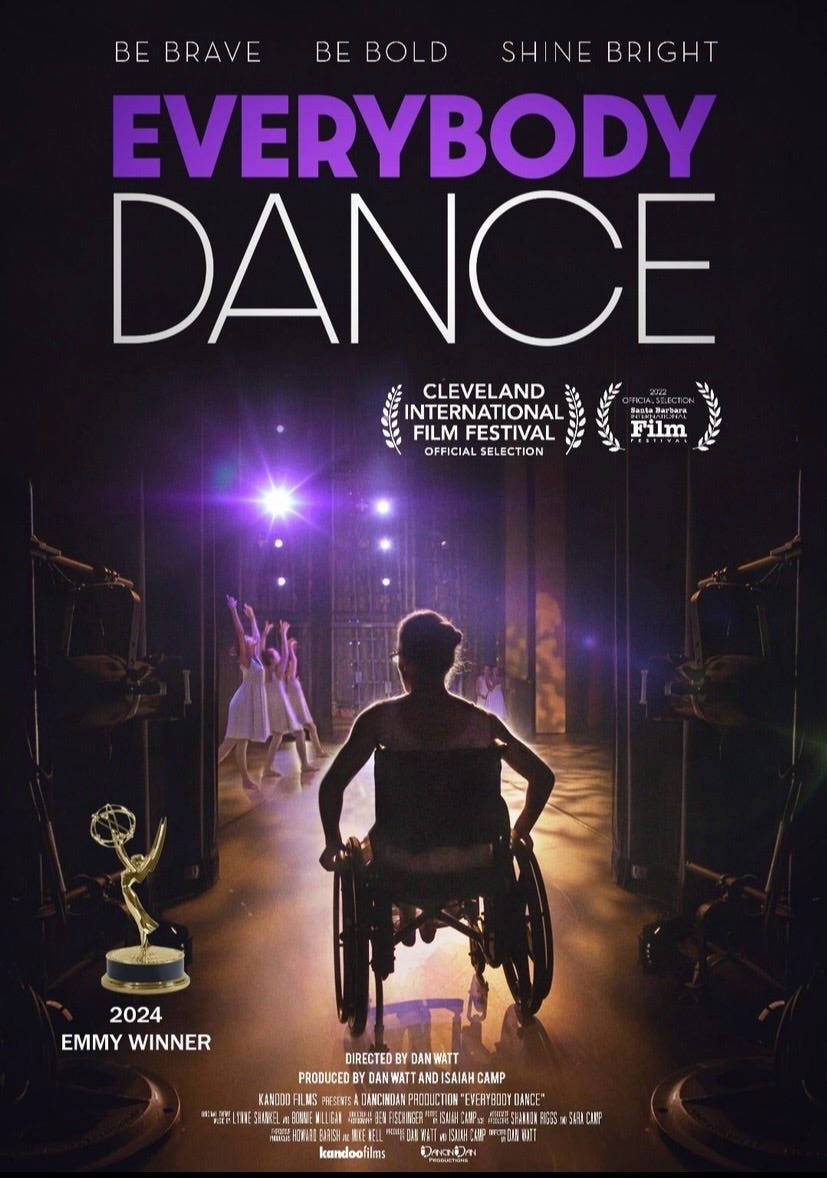
For Developmental Disability Awareness month, A11y News invites filmmaker and former dance teacher, Dan Watt, to explore his 2022 documentary Everybody Dance. The film follows a ballet class at Ballet for All Kids, revealing how a shared artistic space can become a safe space for families navigating diagnosis, resource gaps, and raising kids with confidence. Dan shares what viewers can expect, the lessons he has learned during the filming process, and his perspective on the evolving representation of disability in media.
Where to watch Everybody Dance Documentary
Everybody Dance is currently free to watch on YouTube, but if you are subscribed to streaming services, make sure to watch the documentary there as well:
Snippets from the Interview
Laura Wissiak: Without spoiling too much, could you give us a quick rundown of what listeners can expect?
Dan: The title might sound intimidating, but the film is really about dedication, determination, and community. I followed these kids for ten months as they prepared for their recital, and the movie ends with that performance. Viewers will see the whole process—from the first rehearsal to the final stage—showing how the studio becomes a supportive family.
Laura: A recurring theme in the documentary is the lack of access to resources—information, physical‑therapy, support services—after a child’s diagnosis. How has the shared ballet space helped families navigate this?
Dan: Ballet for All Kids, founded by Bonnie Schlachte, created a safe, judgment‑free environment where parents and children can connect. New families sit in the lobby while longtime members share tips about regional centers, therapists, and other resources. Parents can vent frustrations, ask questions, and receive guidance from those who have already been through the system. It turns the studio into an informal network that eases the mental load of finding support.
Laura: Do you think this community building has impacted the children’s self‑confidence, and has that confidence carried over into other parts of their lives?
Dan: Absolutely. The discipline of ballet—regular warm‑ups, repetition, and structure—translated to home routines. For example, Liam learned to unpack his lunchbox and organize his backpack, habits he hadn’t mastered before. Watching the kids master choreography, celebrate small victories, and high‑five each other boosted their confidence. That confidence showed up at school and at home, helping them tackle everyday challenges.
Laura: What have you learned about access to artistic practice through this project?
Dan: Arts can be a powerful equalizer, but only when they’re truly inclusive. I discovered that many studios offered only short, fragmented sessions—ten minutes of dance followed by unrelated activities. Full‑hour classes, like Bonnie’s, allow deeper engagement and skill development. Since the film’s release, more studios are adopting longer, fully integrated classes, and several have reached out to replicate the model. Bonnie even provides lesson plans and music on the Ballet for All Kids website, making it easy for others to adopt her approach.
Laura: Bonnie’s teaching seems to embody Universal Design for Learning (UDL). Can you elaborate on how she applies those principles?
Dan: She presents each step in multiple ways: verbally, visually, rhythmically, and kinesthetically. For instance, a movement might be described as “left, right, left,” counted “one, two, three,” and accompanied by a rhythmic “bop‑bop‑bop.” This multimodal approach ensures every learner can connect with the instruction in the way that works best for them.
Laura: You have a background in both dance and filmmaking. How did you prepare for filming with children who have disabilities, and have you worked with this population before?
Dan: My first experience was teaching two autistic cousins about 18 years ago. I asked the mother what accommodations were needed—she mentioned sensory sensitivity and the need for visual cues. I applied those lessons when filming: keeping the crew small, using handheld cameras to stay unobtrusive, and staying flexible. I also consulted parents extensively before each shoot. My prior work at Columbia Pictures and with Simon Cowell gave me a solid grounding in production logistics, but I had to adapt those skills to a more intimate, child‑focused setting.
Laura: Can you describe a moment when you had to adjust your filming approach on the spot?
Dan: Our first day in the studio was chaotic—kids were climbing tripods like monkey bars and trying to pet a “caterpillar.” Realizing the three‑camera setup was overwhelming, I asked the head cameraman to switch to a shoulder‑mount rig and we became “fly‑on‑the‑wall” observers. This minimal intrusion allowed the children to focus on dance rather than the equipment.
Laura: How do you avoid the overly inspirational framing and instead portray genuine disability joy?
Dan: I let the families tell their own stories without imposing a narrative of triumph over tragedy. After several meetings with Bonnie and the parents, we agreed the film would be a “fly‑on‑the‑wall” piece, capturing moments as they happened. By presenting the kids’ everyday experiences—mistakes, laughter, perseverance—we highlight joy and authenticity rather than a forced inspirational arc.
Laura: From an industry perspective, have you noticed any shifts in disability representation in media?
Dan: Yes. Shows like Pit cast actors who actually have the disabilities they portray—autistic doctors, a psychiatrist in a wheelchair—without making the disability the focal point of the character. Similarly, live events now include sign‑language interpreters throughout broadcasts, not just as an afterthought. These changes signal a move toward authentic, normalized representation.
Laura: Any parting words for our listeners and readers, or a teaser for upcoming projects?
Dan: The arts are often the first to be cut, yet they’re a universal language that builds community and amplifies diverse voices. I’m currently working on two new documentaries: one with Broadway producer Daryl Roth (think Kinky Boots) and another with Rosie O’Donnell, exploring how YouTube shows like Inanimate Insanity and Battle for Dream Island resonate with autistic audiences. I hope these projects continue to spotlight the power of inclusive creative spaces.
About Dan Watt
After ten years of working for major film studios, including Columbia Pictures and SYCO - Simon Cowell’s Production Company, Dan Watt decided to focus on stories exploring the human experience, humanity, spirituality, and social issues. He is the producer & director of the 2024 Emmy-winning Documentary EVERYBODY DANCE. Dan was also a producer on the award-winning film THE CENTER: Gibbons and Guardians featuring Jane Goodall. He is currently in production on an “Untitled” documentary with Tony and Pulitzer Prize-winning producer Daryl Roth and working on another film centered on autism with Rosie O’Donnell.